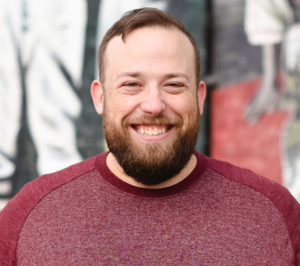
Hurry Up and Wait
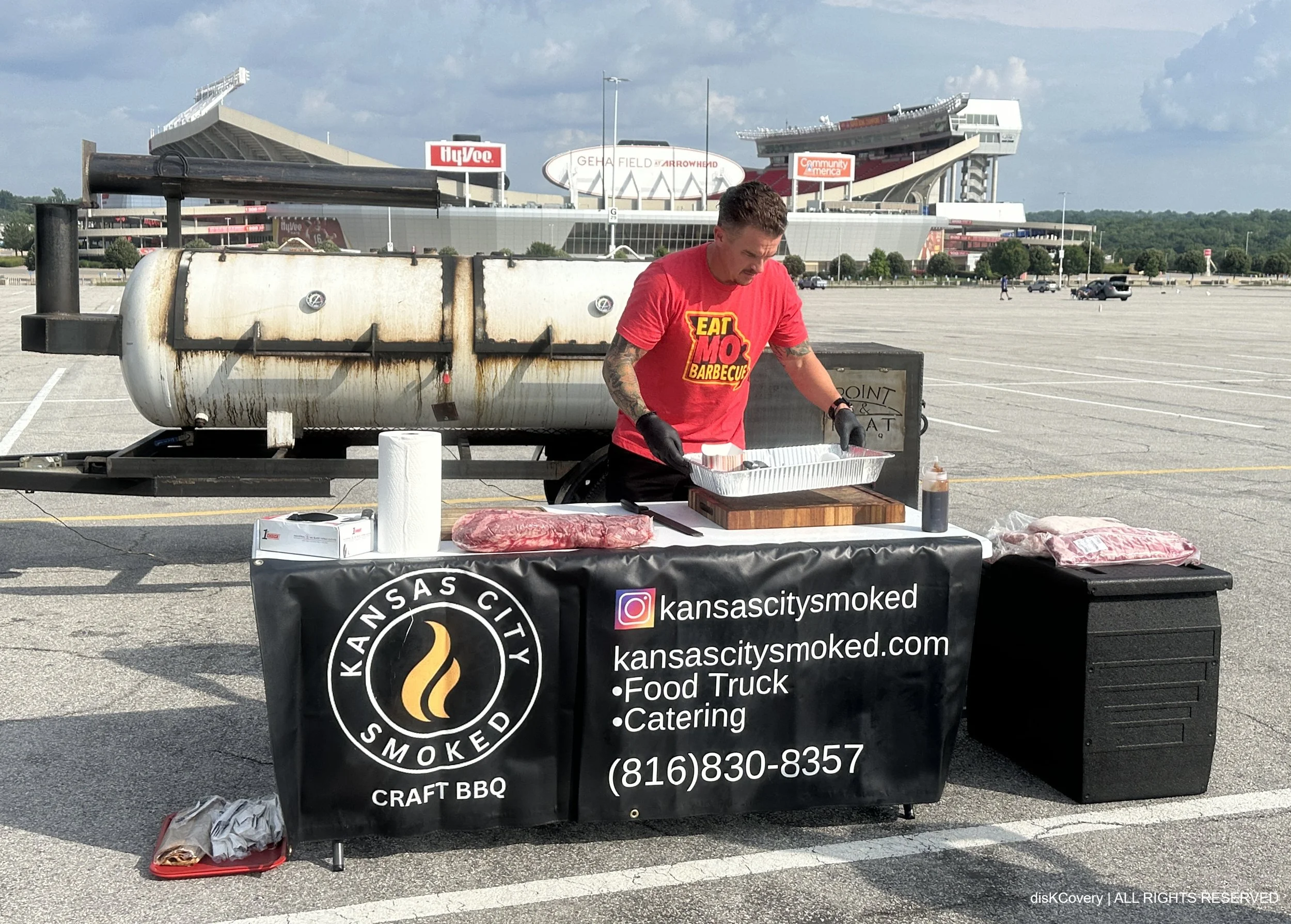
Ronnie Oswald (Kansas City Smoked) preps his station for ESPN’s Last Train to North America. PHOTO CREDIT - disKCovery
Kansas City Smoked’s Road to ESPN
Published June 3, 2026
“Hey man, did you get a DM from this guy? Seems really spammy … but I saw you follow him… says he’s a producer doing a barbecue story about Kansas City and Arrowhead.”
Ronnie Oswald wasn’t the only one asking the question. I had my own doubts.
A couple days earlier, I had received a similar Instagram message from a man claiming to be a producer for ESPN International. In anticipation of the 2026 FIFA World Cup, ESPN was assembling a series of features on the host cities. For Kansas City, they wanted to talk about barbeque.
It didn’t feel real.
The producer’s name on Instagram didn’t quite match the one on LinkedIn. When I tried to move our conversation to email, messages weren’t coming through. There were gaps, delays, and small inconsistencies that were enough to raise an eyebrow. In those first few days, the only thing keeping it afloat was an @espn.com email. Even that felt like it needed a second look.
“I fear you are right in terms of the email situation,” the “producer” told me, “it is worrying.”
I wanted to believe that it was ESPN acknowledging my concern. I needed to believe it. So did Ronnie. Perhaps that’s why, in that moment - though Ronnie and I had barely met - we chose to take that leap of faith together.
The margin between a story being told and disappearing into the ether is thinner than many would like to admit. Sometimes it’s an email that doesn’t send. Sometimes it’s poor timing. Sometimes, it’s simply a matter of trust.
We had to decide if we could trust this Instagram account. We had to figure out which side of that margin we were on.
And the clock was already ticking.
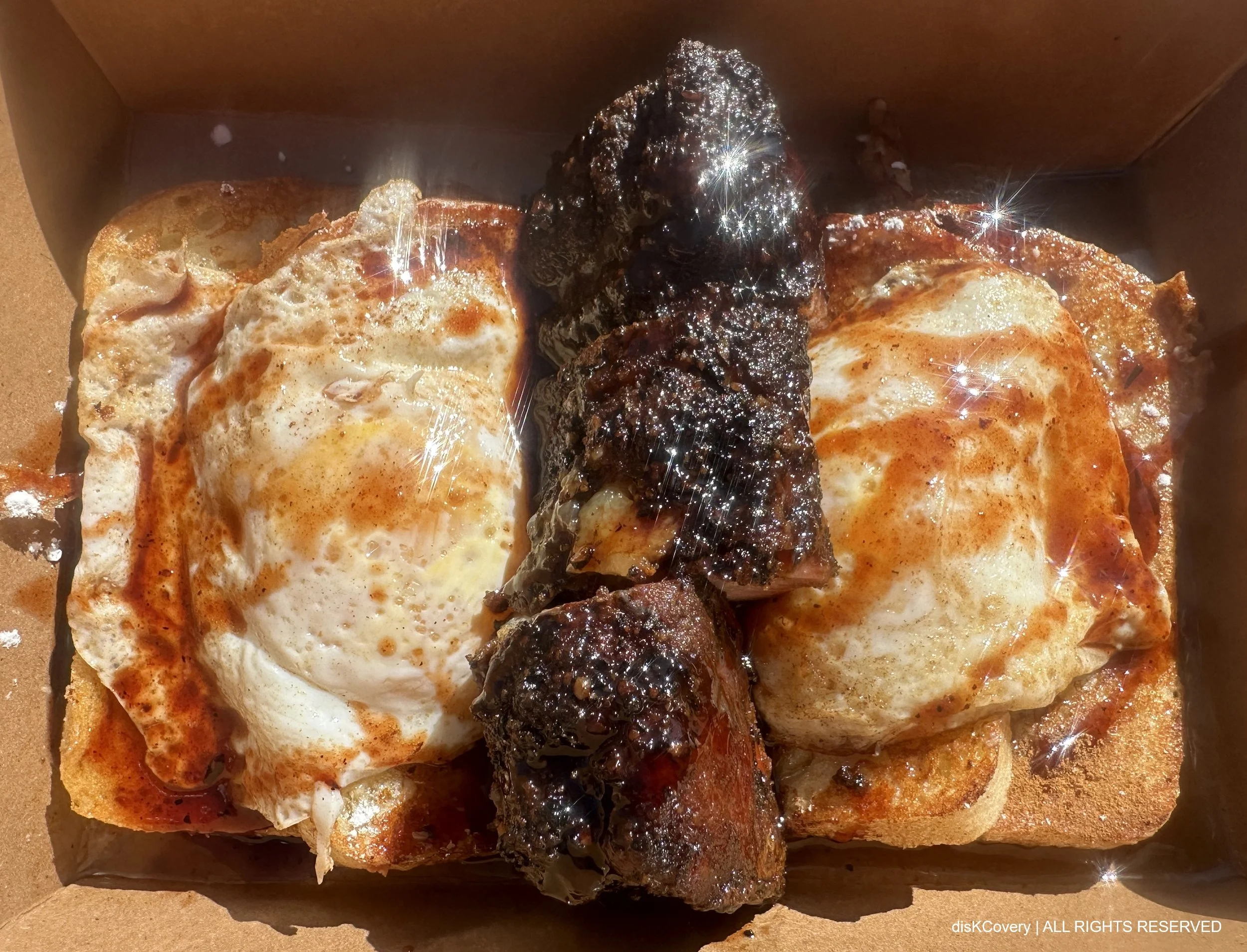
The Pork Belly French Toast from Kansas City Smoked.
PHOTO CREDIT - disKCovery
A month earlier, I hadn’t met Ronnie Oswald. I’d never tasted Kansas City Smoked.
On May 3, 2025, that changed at the Overland Park Farmers Market. Tyler Shane and I were there doing research for an upcoming barbeque feature for Kansas City Magazine. Oswald’s truck was set up near the edge of the market: heated cabinet in tow, folding table out front, and a flat iron griddle working beside it.
The menu leaned towards breakfast that morning. We were lucky to get one of the last slices of Texas-style brisket, along with a chorizo breakfast burrito. But the standout was something unique: Pork Belly French Toast. Crispy chunks of smoked pork belly, glazed with a homemade blackberry barbeque sauce, served atop an over-medium egg and French toast made with Fox & Bull brioche. Everything about it just worked.
Shane summed up the craftsmanship better than I ever could when she called out to Oswald: “Anyone who can make a perfect over-medium egg in a parking lot has my respect.”
For Oswald, and for me, that line stuck.
Her Kansas City food credibility validated what I was already feeling. This wasn’t just another barbeque truck. The quality was exceptional. The menu was deliberate.
Kansas City Smoked was something special.
“I decided I had to take a chance in case it was real,” Oswald recalled.
Wrestling the same doubts, I finally asked for a direct email address, since ESPN’s messages weren’t coming through. I pressed send and waited.
And then, things shifted.
A reply came back. Then, another. I was looped in with a second producer with ESPN Originals who would be on site, and suddenly, it no longer felt like speculation. There was forward motion. Not smooth motion, but it felt like things were on track all the same.
Speaking of tracks, that was the concept.
The team was building Season 5 of the Emmy-nominated series Last Train to … following correspondent Martin Ainstein as he explores global sporting events, and the cities that host them, through the lens of the train routes that link them. Their focus had turned to the 2026 FIFA World Cup and its 16 host cities.
For Kansas City, the story was barbeque. The setting was Arrowhead Stadium’s renowned tailgating scene.
On paper, it was simple. In practice, it was anything but.
The ESPN team was moving quickly. They were already in contact with the Kansas City Chiefs and Union Station. Filming access to Union Station was secured. Travel was booked. A production schedule was forming around a June 15 shoot.
And yet, just as quickly as things came together, they would stall.
ESPN was working on getting approval from Arrowhead Stadium. Less than two weeks out, they still hadn’t secured a pitmaster. There was also a disconnect around what barbeque actually is.
Barbeque is characterized by bursts of activity followed by stretches of measured patience. There’s urgency to build a fire, and then patience in letting it burn. Speed to trim and prep the cut, but then the cook itself is low and slow. When the time is right a pitmaster must act fast, but only after enduring long stretches of stillness where the flavors are revealed. As Oswald put it, “Resting [smoked] meat for four to twelve hours really unlocks the magic.”
Television production, it turned out, followed a similar pace. Hurry up, then wait.
To their credit, the ESPN team understood what they didn’t know. As they worked to merge Midwestern tailgating and Kansas City barbeque into a unified theme, I helped draw the distinction between true barbeque and parking lot grilling.
And while ESPN believed they were still searching for the right pitmaster, they had already found him.
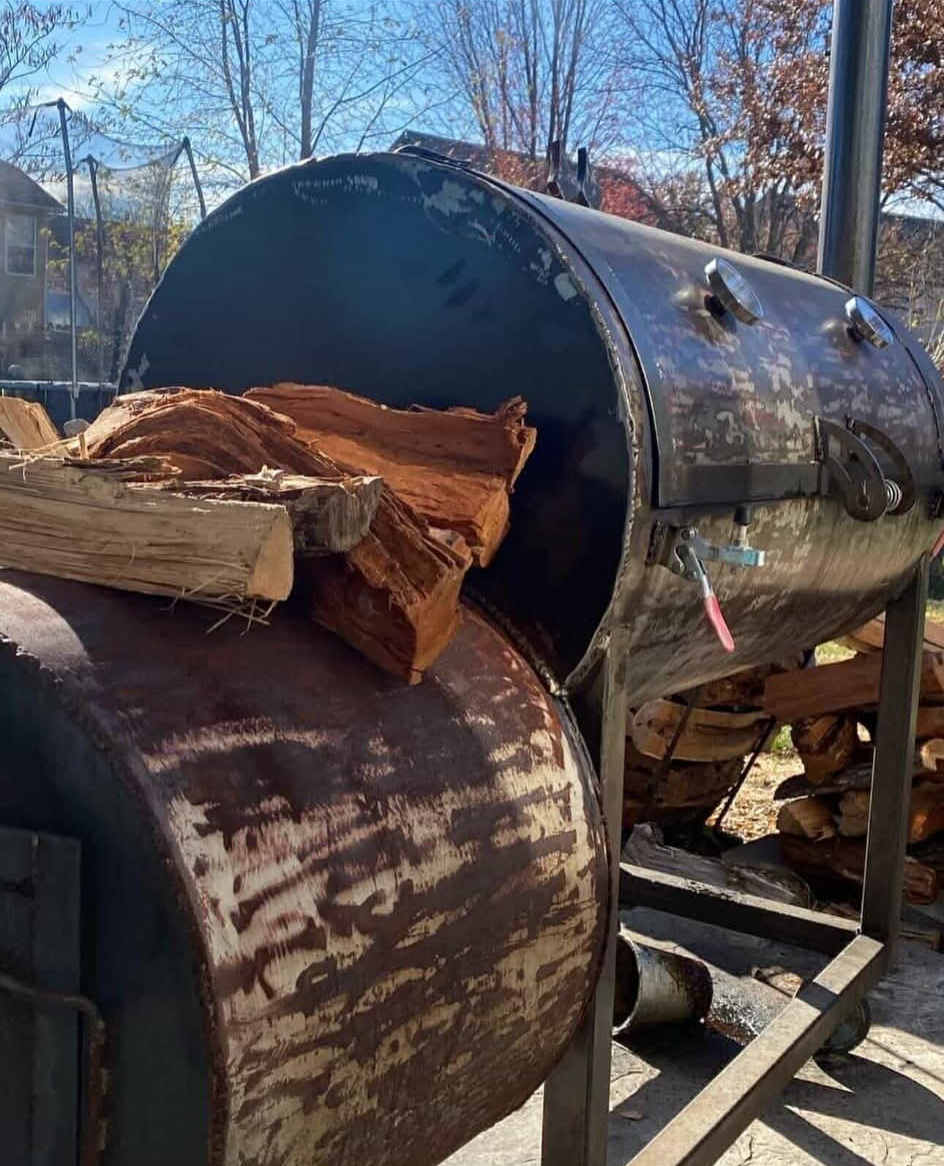
This 90-gallon smoker was the first one Ronnie Oswald built. PHOTO COURTESY OF: Kansas City Smoked
The first time that Ronnie Oswald ever heard the term “craft BBQ” was during the COVID-19 pandemic.
Years later, as a purveyor of it, he still finds the label complex. To him, craft barbeque is an all-encompassing idea that begins with quality ingredients and extends to every step that follows: the trim, the preparation, the use of live fire, the type of smoker, and even the final presentation.
“With craft, I think you should be doing your whole menu from scratch,” Oswald said, “making your own sauces, sides, and sausages.” Kansas City Smoked isn’t quite there yet. An in-house sausage program is still in the works.
Embracing that philosophy, Oswald takes the notion of scratch-made to a whole other level. Around the time he first heard of craft barbeque, Oswald picked up welding. “I became good enough that I could build a smoker.”
In 2021, he built his first from a 90-gallon propane tank. It’s a delicate process. “The first time I cut through a tank, I was scared I would blow my whole house up,” Oswald said. Thankfully, he didn’t. Shortly after he built that first smoker, he started selling brisket by the pound in his neighborhood.
The next build was three times the size. Soon, Kansas City Smoked was popping up across the metro at breweries, wineries, and events.
High-level barbeque that didn’t need walls, Kansas City Smoked could exist anywhere - including a stadium parking lot.
“What is a must in KC BBQ? Is it all about the sauce?”
“Sauce is a tricky subject. It’s such a massive part of our barbeque culture, tradition, and history. BUT, let me be clear, it’s all about the meats! Quality cuts that are smoked low and slow over wood(s) of the chef’s choosing. … Great barbeque doesn’t need sauce, but a great sauce always makes it better.”
As the producers and I exchanged emails to better define Kansas City barbeque, and provide context on what they should prioritize visually, a wide net was cast across the local scene. A number of pitmasters were considered, each with their own strengths and styles.
But as the concept took shape - mobility, operating in a tailgating environment, barbeque quality, and availability - it became clear Ronnie Oswald fit the direction best. An interview confirmed it.
With Kansas City Smoked locked in, it was time to wait.
Two days out, ESPN was still awaiting final confirmation from the Kansas City Chiefs.
Then, 24 hours before filming, word came through: production was a go. Broadway Butcher Shop the following afternoon. Arrowhead Stadium after that.
Suddenly, it felt very real.
I arrived at Broadway Butcher Shop early. Ronnie Oswald had already beaten me there.
His black Ford F-150 sat out front with the smoker in tow. Before anything else, he stepped inside to speak with the counter staff and let them know what was about to happen. Cameras and crew were on the way. There was hesitation at first. Nothing about this was normal for a working butcher shop.
Then Oswald flipped it.
“When I told them ESPN was paying for everything and I was going to cook up some of that brisket and bring it back to them, they were on board.”
Right on cue, a black Mercedes sprinter van pulled up. The director, producer, and camera crew unloaded quickly, setting the stage. And just like that, a cadence was established: reset, restage, repeat. Ronnie Oswald walked through that front door more times that day than he probably ever had.
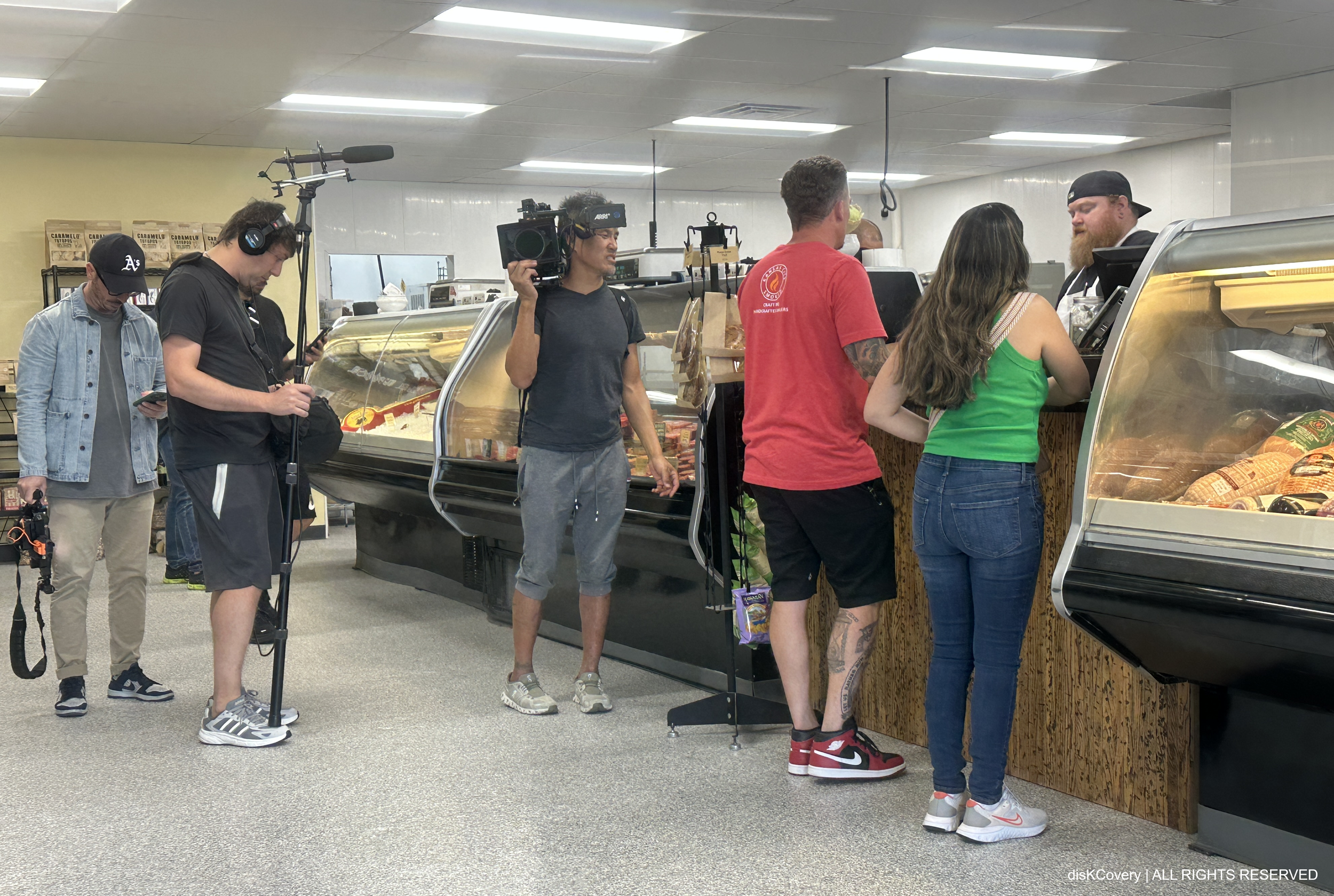
Filming for the KC segment of Last Train to North America began at Broadway Butcher Shop in Westport. PHOTO CREDIT - disKCovery
As customers came and went, confusion lingered in the background. Production paused, resumed, then reset again. Once Oswald’s entry was good, it was time for him to select his cuts. And then, to do it again. Each movement required set-up. Each set-up required waiting.
About an hour later, nearly $400 worth of product was packed into a cooler in Oswald’s truck bed. The director and a camera operator climbed into his truck while the rest of the crew loaded into the van. We rolled towards the Truman Sports Complex.
One camera tracked the truck and smoker down 39th street from the van. Another, inside the cab, captured Oswald’s perspective.
Earlier emails had acknowledged that barbeque would take longer than the four-hour window planned at Arrowhead. Oswald knew to make the necessary adjustments. But somewhere between pre-production and execution, that detail hadn’t fully translated to the crew.
So when the camera operator in the truck asked how long it would take to set-up before cooking could begin, the answer wasn’t what they expected.
Twelve hours to cook. Twelve more to rest. The silence that followed didn’t need translation.
Barbeque and television may share a rhythm, but they don’t share a rhyme. Barbeque is slow, variable, and real. It’s bound to the fire, the meat, and the moment. Television, by contrast, is fast, timed, and controlled. Barbeque is shaped by the elements, while television shapes those elements into something digestible.
We arrived at the stadium and pulled into Lot G. From there, it became the same cadence again - reset, reposition, repeat - as the crew searched for the perfect entry shot.
Then it was time to move inside the stadium, but space was limited. The ESPN crew rushed ahead, while Oswald and I stayed back.
It was a blistering day. Across the parking lot, the Royals were playing the A’s. At first, we stood in the lot, listening to the sounds of the game, but then Oswald cranked the air conditioning, and we sat in his truck and waited.
And talked about barbeque.
“… and I told him that I wasn’t cooking that today. It would have to cook for at least 12 hours, and rest for at least 12 more.”
We both chuckled. Then, the conversation turned to the food.
“With craft, I think you should be doing your whole menu from scratch; making your own sauce, sides, and sausages.”
Ronnie Oswald had a clear plan for what he wanted the hosts to try. The core of it was essentially his trinity.
Brisket anchored the lineup: thick-sliced, with a thin, soft yellow ribbon of fat, and deep pink smoke ring so pronounced it looked hand-painted.
Pork belly followed: rich, golf ball-sized cubes that melted on contact. And then, the pork spare ribs: Kansas City cut, firm, but tender, like a good handshake.
The sides weren’t an afterthought. The elotes - a chilled, Mexican street corn salad - brought a creamy, smoky brightness. The smoked beans leaned sweet with the right amount of sass. And the hearty, smoked gouda mac, which Oswald spoke of with pride, rounded things out.
It wasn’t just a showcase of Kansas City Smoked. It was a reflection of the city itself: a mix of textures, flavors, and influences that define barbeque’s capital.
As the hours passed, we talked about local sports (the Royals’ slump continued with another loss), Oswald’s path to barbeque, and the bonds he’s built with other pitmasters in Kansas City and beyond. We traded our favorite spots around the city, and a few we wouldn’t go back to.
Then Oswald got the text. The stadium tour was wrapping up.
After hours of stillness, Ronnie Oswald was back in motion.
The table was set. The Kansas City Smoked banner went up. He laid out a butcher block, lined up his cutlery, and unloaded the cooler and hot box of sides. Everything found its place quickly, like it had been rehearsed a hundred times.
As the last piece settled, the sprinter van rolled up. From there, the action picked up.
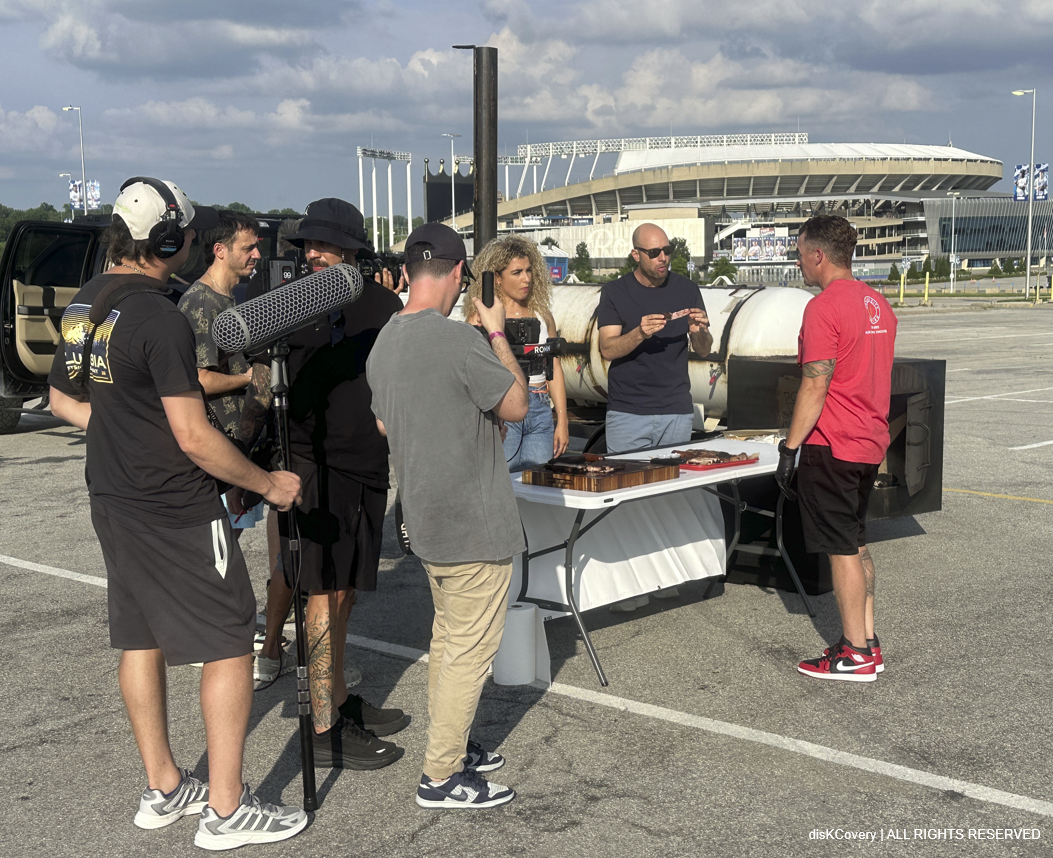
ESPN International’s Martin Ainstein enjoys a bite of a Kansas City Smoked pork spare rib. PHOTO CREDIT - disKCovery
The director asked Oswald to torch the firebox and get some smoke going. Introductions were made. One of the hosts asked, “What is brisket? Is this a Kansas City thing?”
And while the early cadence of resets and repeated entrances would continue, Oswald made one thing clear: when it came to trimming the raw brisket and slicing the finished meats, they were only going to get one chance at those shots.
The action continued and conversations endured - most of which are now lost to an ESPN editing studio somewhere.
At one point, Oswald broke away and ran over to me. “Here. You’ve never had one of my ribs.” It was a perfect bite. He later recalled, “It was the center cut too. That’s the best piece!”
Then, just as quickly as it had begun, it was over.
Oswald pulled out large foil pans of sides and finished slicing the meats. “At the end of the shoot, I just said, ‘Let’s eat this shit.”
During the shoot, Oswald thought the hosts might be overreacting to his food. Then, the crew descended on the trays like a pack of raptors and offered similar praise. Even the mac ‘n cheese - below its ideal temperature and not visually fit for television - was attacked. Host Chelsea Cabarcas, and a few crew members, begged Oswald for the recipe.
Then it was on to the next stop. Union Station for them, and a flight out of town the following morning. For Oswald and I, it was back home.
I remember thinking that the timeline had been tight: two weeks to build it and about 10 hours to shoot it. But this crew was covering all 16 FIFA World Cup host cities in about three weeks.
The next day, the on-site producer followed up to say how impressed they had been with Ronnie Oswald and his food. I passed it on. They moved on to Houston.
And we waited.
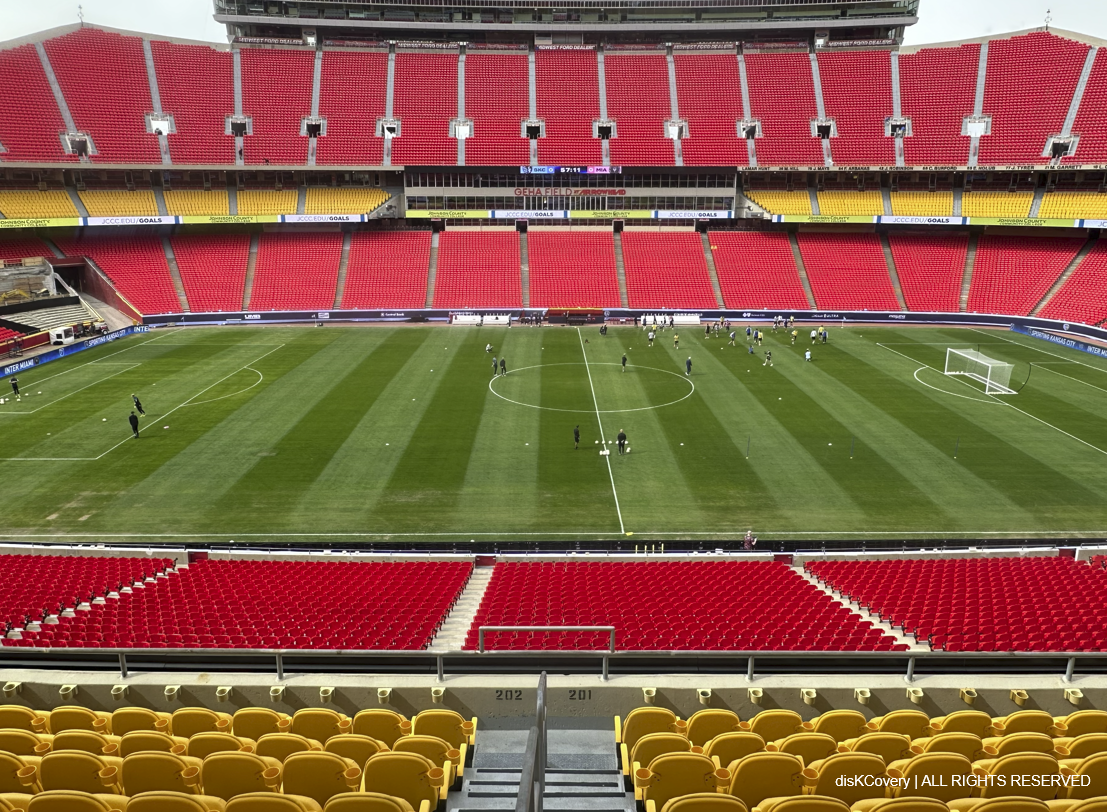
Soon, GEHA Field at Arrowhead Stadium will host 6 FIFA World Cup matches. PHOTO CREDIT - disKCovery
We’ve all heard it. If something seems too good to be true, it probably is.
But every so often, something simply is that good; and still real.
What stayed with me wasn’t the production schedule, or the cameras, or even the pace of the day. It was the contrast in rhythm. Watching how something slow, local, and intentional gets pulled into a medium that’s fast, global, and produced.
Ronnie Oswald never broke his rhythm. Even when everything around him accelerated, he stayed true to his craft.
Not everything that comes together quickly is fragile. Sometimes, everything simply falls into place. Production doesn’t make a story any less authentic; it just frames what already is. Sometimes, the thing that feels improbable is just real.
Like Kansas City Smoked.
Like this city preparing to host the FIFA World Cup.
So, hurry up and watch Episode 7 of Last Train to America.
Hurry up and find out where Ronnie Oswald is popping up next.
And then, wait.
Be sure to catch Ronnie Oswald and Kansas City Smoked on Last Train to North America: now airing on ESPN2, ESPN Deportes, ESPN+, and Disney+!